Case 01 · 2024
Turning unpaid assessment hours into insurer-paid care
Assessments in Connect EMR, a web app for an autism healthcare company
Client: ABA Centers of America, a healthcare company that treats autism. I did the project at ABA Tech, the holding's technology company, on Connect EMR.
- Product design
- UX
- UI
- Research
Videos


- Business challenge
- Assessment results lived in loose PDF and Excel files, and half of the treatment plans were missing them. Without that evidence, the clinics could not prove the service to insurers, who approved 9 hours per assessment while the real work took 5 to 7 hours more.
- My contribution
- As Senior UX/UI Designer, I researched with clinical roles, BI and billing, mapped the assessments journey, defined the MVP flow and designed it with Crayon, the design system I created.
- Key result
- Insurers started paying the effective assessment hours: USD 80K+ recovered in the first year (BI hours and appointment data cross-checked with billing), and approx. 100+ appointment hours freed in the first quarter (estimate from clinical team interviews and a later review).
Business challenge
An assessment is the first clinical step for a person to become a client of a healthcare company that treats autism. Assessments happen on third-party websites. When they finish, users download PDF or Excel files with the results.
The business needed those results centralized inside Connect EMR and linked to the client’s treatment (Tx) plan. The objective agreed with the business was an absolute 10% reduction in client information loss in the first quarter after release to production.
What stakeholders told me:
- 50% of the Tx plans had missing assessment information.
- Missing information caused re-work and additional costs.
- Tx plans lacked the assessment evidence insurers need to approve billing units, so fewer units were approved.
- The business needed all the information centralized for future automation features.
What end users told me:
- Updating Tx plans is time-consuming, and the approved billing units are not enough.
- Many users forget to update Tx plans correctly.
- Tracking assessments done on third-party websites and then updating the Tx plan is inconvenient.
Role and contribution
I worked as Senior UX/UI Designer at ABA Tech.
Product design
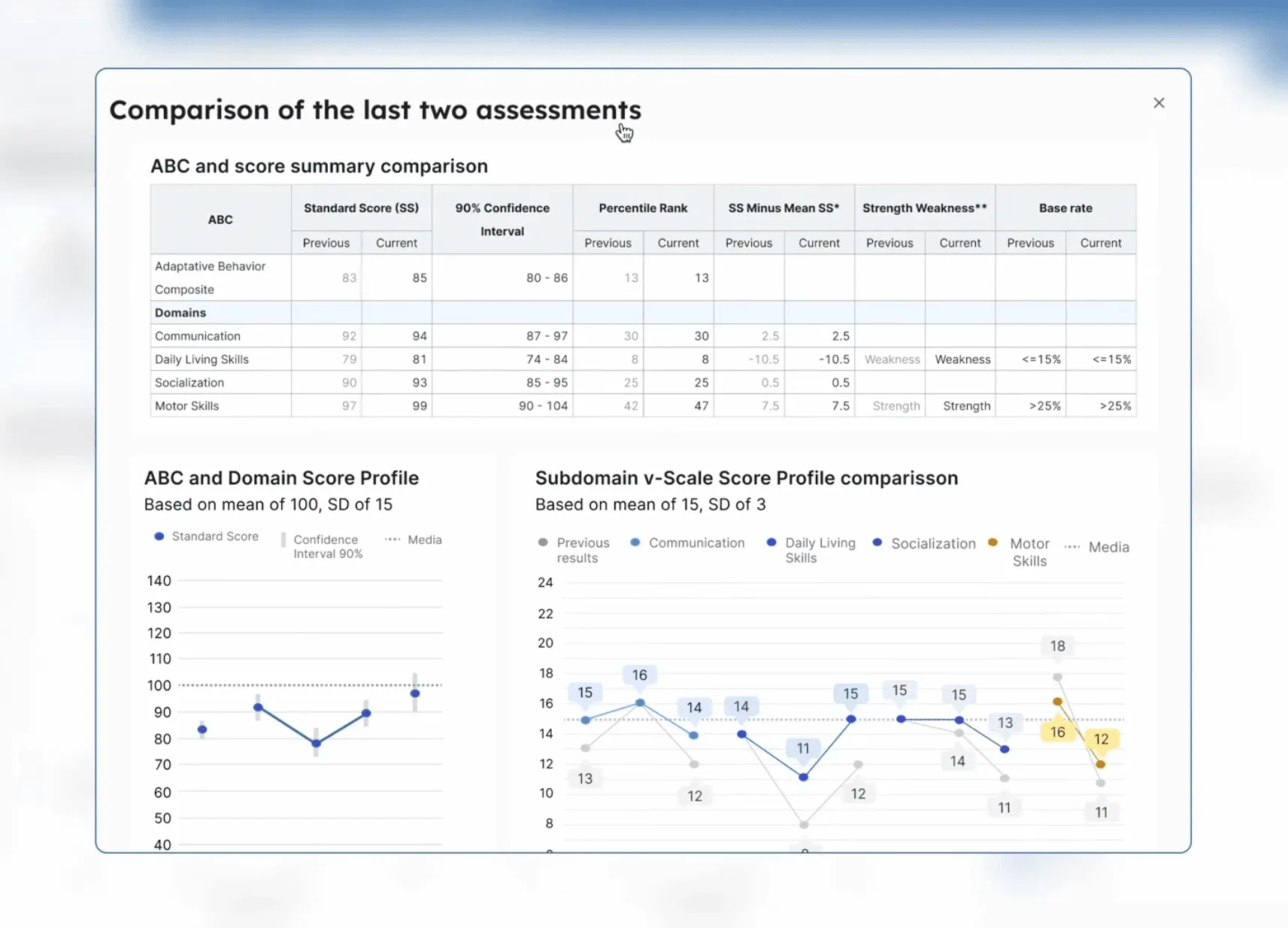
I defined the MVP scope and user flow. I also proposed exploratory features for future iterations: a treatment plan suggestion based on assessment results (deferred from the MVP, see Key decisions) and a before-and-after comparison of the last two assessments.
UX
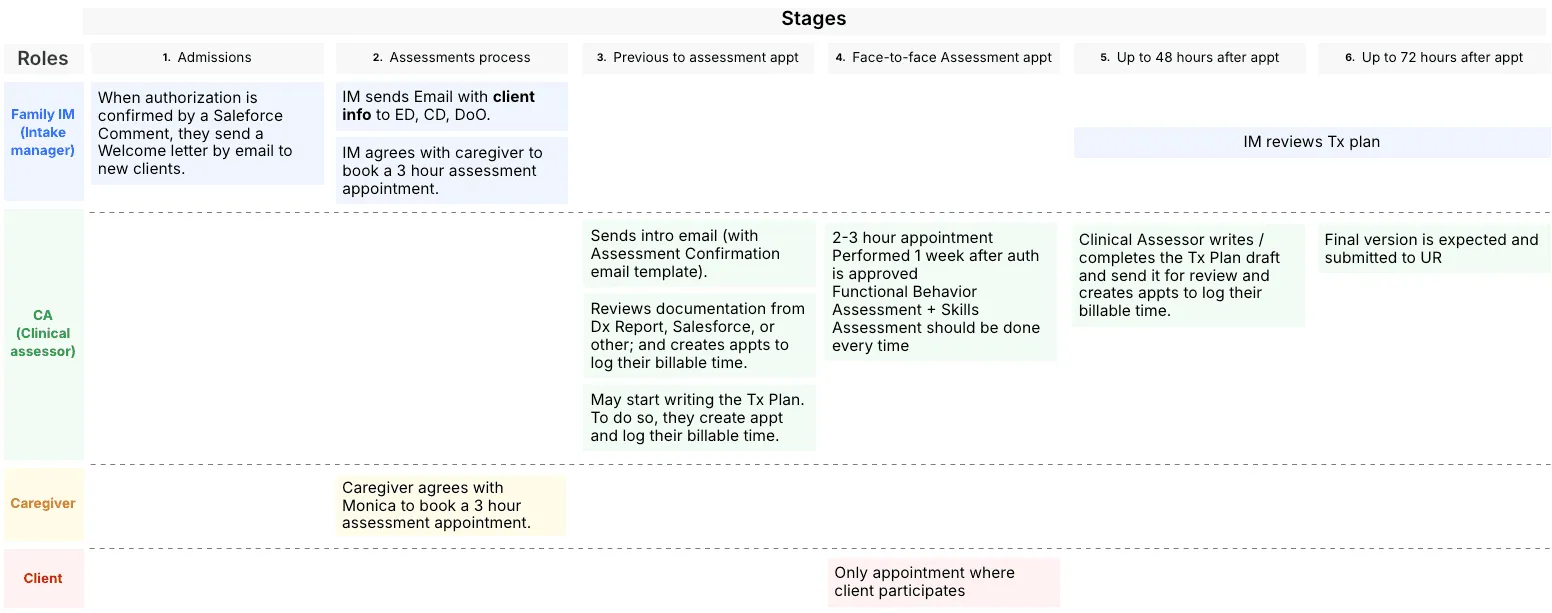
I structured the assessments journey by stages and roles. Then I defined the MVP flow: log in, clients list, client profile, Assessments tab, upload file, set the assessment type (AFLS, Vineland and others) and the completion date. The upload date is recorded separately. The Tx plan is linked automatically when there is only one. Otherwise the user picks it.
UI
I designed the MVP with components from the Crayon design system: modals, alerts, badges, buttons, inputs, chips, stepper, loaders and file upload. The final UI includes a comparison of the last two assessments, with a score table and score profile charts.
Research
- Sessions with business stakeholders to understand the process.
- One-on-one interviews with clinical roles.
- Hours and appointment data requested from the BI team and cross-checked with the billing team.
- User validations of the proposal.
Approach
I followed a user-centered process: stakeholder and end-user research, findings, the assessments journey (stages and roles), the MVP user flow, the MVP UI with the design system, user validations, and exploratory features for future iterations.
The journey has six stages: Admissions, Assessments process, Before the assessment appointment, Face-to-face assessment appointment, Up to 48 hours after the appointment, and Up to 72 hours after the appointment. The roles are the Family Intake Manager (IM), the Clinical Assessor (CA), the Caregiver and the Client.
Tools and how they were used
- Crayon design system (Crayon UI 1.0.1): the design system I created. This project applied it.
- Figma: the MVP design proposal, the prototype and the components.
- FigJam: the assessments journey map and the user flows.
- Jira: user stories and follow-up with the development team.
- Claude: an AI copilot for design tasks, flows and copy, and for designing the interview guides and processing the collected data.
Key decisions
- Upload and classify, not integrate.
- I chose an MVP where clinicians upload the result file and tag its type and completion date, over integrating with each third-party assessment website.
- Integration meant authentication work with every third party, which would have grown the scope and pushed the MVP deadline.
- The cost is a manual upload step in the clinician’s routine. Clinicians accepted it: assessment results are mandatory in the Tx plan, and having them centralized in the system was worth the step.
- A standard list of 12 assessment types, not free text.
- I chose a closed list of about 12 types, built with the business by reviewing existing assessments and the third-party sites used most, then validated with the business. I did not let clinicians name any assessment freely.
- Homogeneous data made uploads consistent and laid the ground for automation on top of the results.
- The cost is that clinicians lost freedom at first. They were reluctant and felt it as a temporary pain while new types were added in later increments.
- A before-and-after comparison, not just a history list.
- I chose a comparison of the last two assessments, with score tables and score profile charts, over the history list the business asked for.
- Returning patients are re-assessed. The clinician defining the new Tx plan needs to see whether the patient evolved or a new behavior appeared that the plan must address.
- The cost is that the view does not show long-term trends across many assessments. The proposal was well received.
- Defer the suggested treatment plan, not ship it in the MVP.
- I left the treatment plan suggestion out of the MVP. It would be based on assessment results, which indicate where each patient sits on the autism spectrum. The standardized data prepared the ground for it.
- Shipping it from day one would have grown the MVP scope, and it opened an intense debate on whether clinicians would lose the ability to define a plan specific to each patient.
- The cost is that clinicians still build every plan by hand for now. The team agreed the suggestion is part of the system’s evolution.
- Link the Tx plan automatically.
- I chose to link the uploaded assessment to the client’s current Tx plan automatically, and to ask only when there is more than one plan. I did not ask the user to pick the plan every time.
- Every client needs one current Tx plan that backs the services provided, and research showed users forgot to update their plans.
- The cost is an extra selection state for the less common case.
Edge cases and states
- One Tx plan or several: auto-link when there is one, a selection step when there are more.
- Completion date and upload date: both are recorded, so late uploads do not distort the clinical timeline.
- Assessment types with different structures: normalized by the standard list.
- File type and size limits: the upload component enforces them and has an error state.
Challenges
- Third-party websites: results came back as PDF or Excel, with no direct integration.
- Different assessment types: AFLS, Vineland and others have different structures. The standardized list made every upload homogeneous and ready for future automation, such as the treatment plan suggestion deferred from the MVP.
- Several roles with different needs: Intake Manager, Clinical Assessor, Caregiver and Client.
- Getting clinicians on board: they were reluctant about the closed list and worried that a suggested treatment plan would take away their clinical judgment. The list grew in increments, and I framed the suggestion as a later step in the system’s evolution.
The insurance gap
The biggest challenge turned out to be a billing problem, not only a UX one.
In interviews, clinicians told me assessment results got lost and the service then had to be repeated. That pointed beyond the interface, so I brought the billing team into the research.
I requested hours and appointment data from the BI team and cross-checked it with billing. Insurers approved 9 hours for an assessment, but each case took 5 to 7 hours more. When result files were lost, it was almost impossible to prove to the insurer that the service had been delivered properly.
With every assessment centralized and linked to the Tx plan, the clinics could back the service, and insurers paid the effective assessment hours.
Result and impact
- USD 80K+ recovered in the first year. Source: hours and appointment data from the BI team, cross-checked with the billing team. Insurers approved 9 hours per assessment while the service took 5 to 7 hours more. After the release, insurers paid the effective assessment hours.
- Approx. 100+ appointment hours freed in the first quarter. Source: an estimate from direct interviews with the clinical team and a later review during the implementation.
- Objective for the first quarter after release: an absolute 10% reduction in client information loss, from the 50% of Tx plans with missing assessment information found in research, so down to 40%. Source: the objective agreed with the business. This is the goal, not a measured outcome.
- Critical path of patient care. The process is now part of the critical path of patient care across the clinics in the United States.
How my experience made the difference
- Listening for the cost behind a pain point. “We lose the results” led me to bring BI and billing into the research and uncover the insurance gap.
- Proposing more than what was asked. I designed a before-and-after comparison instead of a plain history list.
- Using my own design system. Crayon let the team ship a consistent MVP fast, while the standardized data prepared the ground for future automation.
- Direct contact with clinical roles. One-on-one interviews revealed the blockers and the alternative flows behind the process.
What I learned
- Bring billing in from day one. The biggest finding came from billing, and it only joined the research after clinicians mentioned lost results. Starting with every team that touches the money would have surfaced it sooner.
- Standardizing takes something away, so say what users get back. The closed list felt like lost freedom until clinicians saw new types arriving in increments. Next time I would share that roadmap with the list itself.
- Automation in clinical work needs the clinicians’ trust before it needs the model. The treatment plan suggestion was debated before it was designed. I would involve clinicians in shaping it as an assistant, not a replacement.
Tools
- Figma
- FigJam
- Jira
- Crayon design system
- Claude
How AI helped
I designed the questionnaires and ran the interviews myself. I used Claude as a copilot to support design tasks, flows and copy, and while designing the research and processing the results. Interpretation and decisions stayed with me.